

When Proximity Determines Funding, The Unequal Reality of India’s NGO Ecosystem

Posted by Dr Satish S.K
CSR & NGOs
Hits: 85
- Article Number: 05
When Proximity Determines Funding The unequal reality of India's NGO ecosystem
There's a version of India's CSR story that gets told at conferences: ₹2.51 lakh crore deployed since the mandate began, a maturing ecosystem, more companies exceeding their obligation than falling short of it. All of that is true. It's also incomplete. Ask any NGO working outside a state capital how CSR actually reaches them, and you'll hear a quieter, more uncomfortable story one about proximity, not merit.
If you plotted every rupee of CSR spend in India on a map, it would not look like a map of need. It would look like a map of corporate headquarters.
CSR inflows have been shifting beyond the metros into Tier-2 cities and industrial belts, with flows to industrial hubs growing 120% and to Tier-2 cities by 55% over the past three years, according to Sattva Consulting's State of CSR in India report. That sounds like real progress until you see the base it's growing from. Tier-1 city districts still absorb close to 30% of all CSR funding, with neighboring clusters accounting for a few percentage points more. A separate industry analysis puts the metro concentration even higher, Tier-1 metros commanding 44% of all CSR funds, even as that share slowly declines.
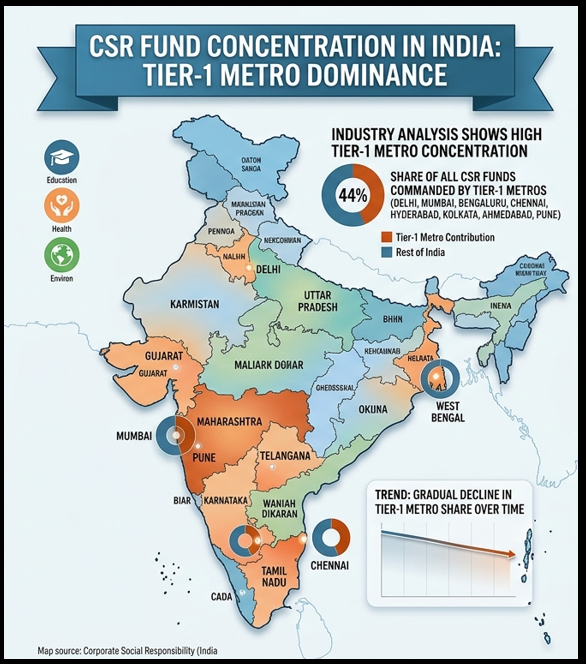
The numbers differ by methodology, but they agree on direction: a disproportionate share of India's CSR money still lands within a short drive of the company writing the cheque — not within reach of the districts that need it most.
That's not an accident of geography. It's an accident of process.
Why "aspirational districts" stay aspirational
NITI Aayog's Aspirational Districts programme exists precisely because 112 of India's most underdeveloped districts needed a deliberate push of public and private capital. CSR funding to these districts has grown 2.75 times over the mandate's history — from roughly 8% of total spend to 22%. Real movement. And yet it remains far below the 30% share that NITI Aayog has set as the target
Why the gap?
When the intent from government, from many corporates — is clearly there? Because CSR isn't allocated by need. It's allocated by ease of verification.
The diligence bar that only some NGOs can clear, Here's what rarely makes it into the glossy CSR reports: getting corporate funding in India today is less a fundraising exercise and more a compliance audit and the audit favors organizations that already look institutional.
Consider what a CSR team is required, & expected, to check before a rupee moves
A corporate donor legally cannot route CSR funds to an NGO without a valid Darpan ID from the NITI Aayog registry the baseline signal that an organization is registered & real.
Under Rule 4 of the Companies (CSR Policy) Rules, 2014, companies must complete due diligence before engaging an implementing partner, with every compliance document cross-checked against the MCA, Income Tax, UDIN & FCRA databases. That process typically consumes six to ten weeks of staff time per NGO partner.
Companies are advised to begin this evaluation six to nine months before a program is meant to start a runway that assumes an NGO already has an existing relationship pipeline, dedicated compliance staff, & the patience to wait.
Reviewers are told to look for three years of audited financials, board composition with independent members, & disclosed related-party transactions & to treat an organization's reluctance to share any of it as a signal in itself.
None of this is unreasonable in isolation. Boards should protect against fraud & mismanagement. But stack these requirements together & you get a filter that a well-staffed, Delhi- or Mumbai-headquartered NGO with a compliance officer & a decade of donor relationships can clear in weeks — & a five-person NGO doing genuinely good work in rural Odisha or interior Chhattisgarh simply cannot, no matter how strong its ground impact is.
This isn't hypothetical. Small-scale NGOs in Odisha have struggled to secure partnerships with technology-sector CSR teams specifically because they lacked the digital transparency tooling those companies now expect — a capacity gap, not an impact gap, that cost them real funding.
The vendor-versus-partner trap compounds itThere's a second, subtler filter at work. The most common mistakes companies make in NGO selection are choosing partners based on visibility rather than capability, prioritising compliance ease over impact depth, & treating the NGO relationship as a vendor arrangement rather than a strategic partnership. A vendor relationship is transactional & short-horizon. A strategic partnership assumes trust built over years.
Guess which kind of relationship a corporate CSR head defaults to under year-end spending pressure & guess which NGOs are positioned to be that "known quantity" when the deadline hits. It's rarely the organisation two states away that the CSR head has never met.
This pattern of concentration isn't limited to geography, it shows up in sector choice too, with education, healthcare & livelihoods together attracting more than half of all CSR spending nationally, largely because these are the sectors with the most mature, most "fundable-looking" implementation partners. Newer or less conventional causes & the smaller NGOs working in them compete for what's left.
Platforms are emerging to close the gap, but they're not a substitute for corporate intent
The market has noticed this friction. A wave of new verification platforms is now trying to compress the compliance layer that currently happens manually & repeatedly for every CSR team, building standardized "trust scores" from government data so a five-person NGO in a Tier-3 town doesn't need a compliance department to be legible to a corporate donor. Aggregator & vetted-channel models are also collapsing what used to be a six-to-nine-month diligence window into something far shorter for companies early in their CSR journey.
These are genuinely useful developments. But infrastructure alone won't fix a proximity problem. A trust score tells a CSR team an NGO is compliant, it doesn't put that NGO in the room, in the site visit, in the founder's WhatsApp group where the next three-year program actually gets designed. Access is still, disproportionately, a function of who a company already knows.
What this means for companies serious about equity not just compliance
If your CSR strategy is optimised purely for defensibility clean paperwork, known partners, easy renewals you will keep funding the same geography & the same shortlist of organisations, indefinitely. That's a legitimate risk-management choice. It is not an impact strategy, & increasingly, it isn't a reputational one either, as ESG scrutiny extends beyond spend totals to where & whom that spend actually reaches.
A genuinely equitable CSR portfolio requires deliberate, uncomfortable choices-
Budget for discovery, not just diligence. Set aside CSR planning time specifically to identify capable partners outside your existing network not just to vet the ones who found you.
Separate compliance risk from capability risk. A Darpan ID & clean audit prove an NGO is safe to fund. They say nothing about whether it's the right organisation for the outcome you want. Evaluate both, explicitly, rather than letting the easier one substitute for the harder one.
Underwrite the ramp-up. Smaller, geographically distant NGOs often need capacity-building support digital reporting tools, MIS systems before they can even meet your due diligence bar. Treat that as a CSR investment, not a disqualifier.
Track geographic distribution as a KPI, the way you already track sector-wise spend. What gets measured against a target the way Aspirational District spend now is what eventually moves.
The uncomfortable bottom line
India's CSR law never m&ated where the money should go but only how much. A decade in, that silence has let geography & institutional familiarity quietly do the allocating instead of need. The organisations doing the most under-resourced, highest-need work are often the least equipped to clear the very due-diligence bar designed to protect the money meant for them.
Closing that gap won't happen through better verification platforms alone. It requires CSR committees willing to treat distance from headquarters as a strategic choice they've been making by default & to start choosing differently.
Partner with Us→ Co-create → Drive Transformation → Achieve Enduring Success.
Ready to turn your vision into reality?
Start today

Head Office
C Block,
Vaishno Solitaire Apartments
Ramamurty Nagar Main Road
Ramamurthy Nagar 560 016
Contact Info
info@trirud.com
Ph: +91 96061 96016